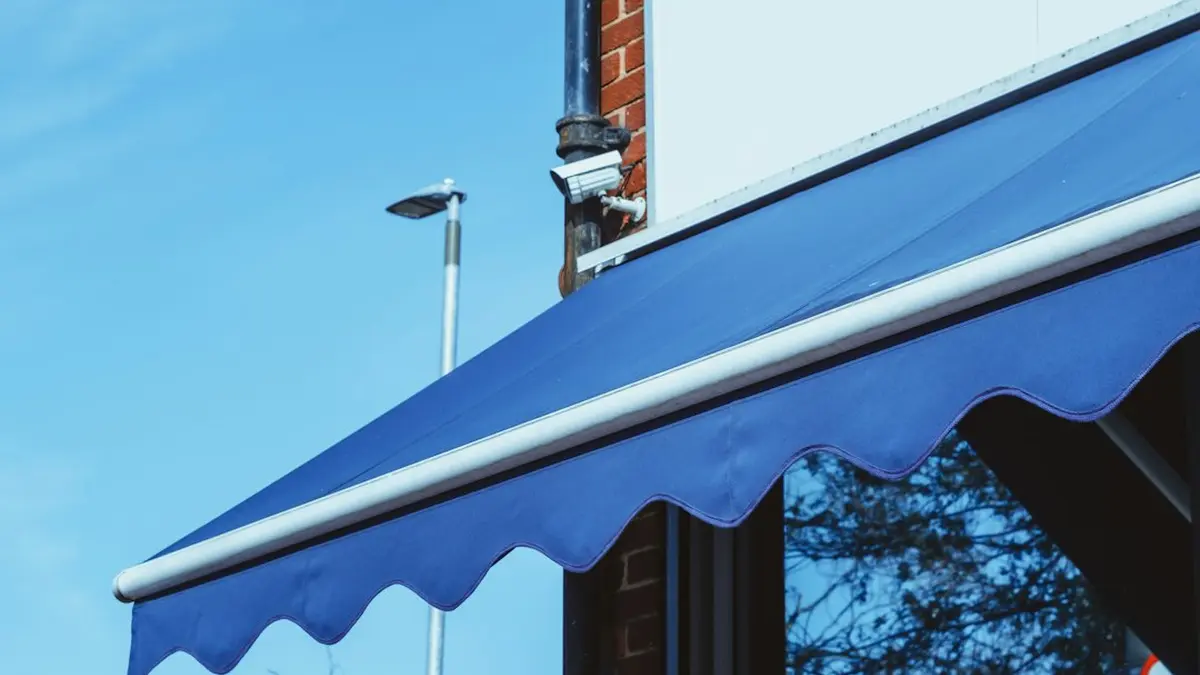
A retractable awning suits a patio or deck that needs shade on summer afternoons and sun in winter. A fixed awning suits a window or entry that needs shade every day of the year, with no one needed to close it before bad weather.
Three things separate them: how each one is exposed to wind, whether winter sun reaches the house, and the up-front cost of moving parts.
The figures below come from awning makers, a cost estimator and code bodies. Each one is attributed to its source. All prices are in US dollars. None of the sources gave UK prices.
Side by side
| Specification | Retractable awning | Fixed awning |
|---|---|---|
| Installed cost, Awning Stars | $1,200 to $4,500 (manual $1,200 to $3,500; motorized $2,000 to $4,500) | $800 to $3,500 |
| Frame lifespan, Door Serv Pro | 15 to 20 years | 20+ years |
| Fabric lifespan, Door Serv Pro | 10 to 12 years | 10 to 12 years |
| Lifespan by material, Awning Stars | Fabric: 10 to 15 years | Aluminum: 15 to 25 years; acrylic fabric: 10 to 15 years |
| Wind rating while exposed, Awning Stars | 25 to 35 mph (40 to 56 km/h) when extended | 130+ mph (209+ km/h), the structural rating for coastal hurricane areas |
| Published heat figure, Door Serv Pro | Cooling costs cut by 25% or more at peak sun when deployed | Solar heat gain cut by 65% to 77% on south windows, 72% to 77% on west windows |
| Winter sun, Door Serv Pro | Admitted when retracted | Blocked year-round by constant shade |
| US permit baseline, IRC R105.2 and LegalClarity | Usually exempt because it folds against the wall; an electrical permit may apply if motorized with new wiring | Window awning exempt only if it projects 54 in (137 cm) or less, is wall-supported and has no posts or braces |
| UK planning, Infinity Awnings UK | Retractable fabric awning on a rear wall: generally not development | Solid-roof veranda or canopy: assessed under Class A permitted development limits |
| Maintenance, Awning Stars and Marygrove | Motorized parts need servicing; fabric must be dry before retracting | Aluminum: essentially maintenance-free |
Retractable awning
A retractable awning is a fabric cover on folding arms. It extends from a wall and closes back against it. It is operated by a crank, a lever or a motor, according to ShadeDocs.
What the sources report it does well
- It can be closed before a storm. AAA Awnings Inc. states that many systems withstand winds up to 100 mph (161 km/h) when fully closed, because the fabric no longer takes the wind load.
- The fabric wears less. Marygrove Awnings states that fabric and hardware stowed when not in use suffer less wear than fabric left out in sun and weather.
- It can close itself. Riser Shade lists vibration sensors at $150 to $200 and anemometer wind stations at $250 to $350.
- It lets winter sun in when retracted, according to Door Serv Pro.
Where it falls short
- The wind limit while open is low. Riser Shade rates budget models at 20 to 25 mph (32 to 40 km/h) and premium models at 35 to 40 mph (56 to 64 km/h). Marygrove rates its own awnings at 25 mph (40 km/h) and advises retracting at 20 mph (32 km/h).
- It cannot stay open in storms, snow or high winds (Door Serv Pro).
- Deep projections are weaker in wind. Riser Shade states that projections of 12 ft (3.7 m) or more are more vulnerable than projections of about 8 ft (2.4 m).
- The fabric must be dry before it is retracted, to prevent mold, according to the Marygrove comparison guide.
- Motors and arms may need repair over time. Installation needs a professional (Door Serv Pro).
Price. Awning Stars gives $1,200 to $4,500 installed. Homewyse gave a US national average of $18.26 to $25.40 per square foot as of May 2026. That estimate covers a motorized awning with a 10 ft (3 m) projection, stainless steel arms and acrylic fabric with a 5-year warranty. It excludes contractor overhead of 13% to 22%, sales tax, permit fees and structural work. The itemized 129 sq ft (12 m²) sample on the same page totals $6,798 to $8,356, which is higher than the per-square-foot rate gives. The page does not reconcile the two figures. A written quote is the only reliable number.
Who should buy it: the owner of a patio or deck who is home to retract it, or who will fit a wind sensor, and who wants winter sun back.
Fixed awning
A fixed awning is permanently installed and does not move. ShadeDocs describes it as strong and continuously weatherproof despite constant exposure.
What the sources report it does well
- It shades every day without anyone operating it (Marygrove comparison guide).
- It cuts solar heat gain through windows. Door Serv Pro gives 65% to 77% on south-facing windows and 72% to 77% on west-facing windows.
- It lasts long in aluminum. Awning Stars gives 15 to 25 years for fixed aluminum and calls it essentially maintenance-free. Door Serv Pro gives 20+ years for a fixed frame.
- It is simpler and faster to install than a retractable awning (Marygrove comparison guide).
Where it falls short
- It cannot be closed as wind rises. AAA Awnings Inc. states this leaves fixed fabric canopies exposed to sustained damage in storms.
- Fabric fades and weakens under constant sun. Marygrove states that this reduces wind resistance over time. Awning Stars gives 5 to 8 years for polyester fabric under Florida UV, against 10 to 15 years for acrylic.
- It blocks winter sun as well as summer sun (Door Serv Pro).
- In hurricane areas, it must carry a structural rating of 130+ mph (209+ km/h), according to Awning Stars.
Price. Awning Stars gives $800 to $3,500 installed. The source does not state the size these prices cover.
Who should buy it: the owner of a window or entry that needs shade all year, who wants no motor and no daily operation, and who will choose aluminum or acrylic over polyester.
Where they part ways: wind, winter sun and permits
Wind exposure
A retractable awning has a low limit while open and a high limit while closed. A fixed awning has one limit, and it applies all the time.
Samson Awnings states that general self-supporting retractable awnings resist about 20 mph (32 km/h). It states that higher-specification models carry tested and certified EN 13561 wind ratings, expressed in km/h or on the Beaufort scale. Samson also states that torque bar folding arm awnings generally resist wind better than basic self-supporting models.
AAA Awnings Inc. groups retractable awnings into two classes:
Class 2 (Beaufort 5) : Sustained winds up to 25 mph (40 km/h).
Class 3 (Beaufort 6) : Sustained winds up to 31 mph (50 km/h).
Marygrove places Beaufort 5 at 17 to 21 knots, when small trees in leaf sway. It advises retracting at Beaufort 4, when dust and loose paper lift. It also states that a steeper pitch sheds wind better than a flat pitch.
If a retractable awning will be left open with no one home and no sensor, its open wind rating is the one that counts.
Winter sun
If winter sun on a window or patio is wanted, a fixed awning works against it. Door Serv Pro states that a fixed awning gives the same shade all year and cannot adapt to seasonal sun angles. A retractable awning admits winter sun once it is retracted. None of the sources gave sun angles or the projection needed for a given window. To find which way a window faces and its hours of sun in each season, use Which way does my garden face?.
Snow
No source gave a snow load rating for either type. Door Serv Pro states that a retractable awning cannot stay open in snow. Do I Need a Permit states that wind speed and snow load requirements are set by location in code tables R301.2 and R402. If the house is in a snow area, ask the installer for the rated snow load of a fixed awning in writing.
US permits beyond the baseline
LegalClarity states that retractable awnings usually fall on the exempt side because they fold against the building. It states that a motorized model may still need an electrical permit if new wiring or a dedicated circuit is installed.
Do I Need a Permit gives these thresholds and costs:
- Retractable fabric awnings under 6 to 8 ft (1.8 to 2.4 m) of projection, with no electrics and no new footings: typically exempt.
- Permanent canopies projecting 3 ft (0.9 m) or more, or with solid roofing, new posts or footings: typically need a permit.
- Simple retractable permit, where required: $50 to $100, approved over the counter in 1 to 2 days.
- Permanent mid-size canopy permit: $100 to $300, with standard review of 2 to 4 weeks.
- Electrical sub-permit: $25 to $75.
- Structural engineering: $800 to $2,500.
The 3 ft figure from this guide is shorter than the 54 in figure in the IRC. The local adopted code decides which applies.
UK planning permission
Infinity Awnings UK states that a retractable fabric awning fixed to a rear wall is generally not a building operation. In most standard cases it needs no planning application. A veranda or canopy with a solid, permanent roof is assessed under Class A permitted development limits, as an extension is. Permitted development rights are commonly restricted in Conservation Areas, National Parks, AONBs, World Heritage Sites and the Broads. An Article 4 direction can remove them. If either applies, contact the local planning authority first. The sources do not cover fixed fabric awnings without a solid roof.
Which to buy
Buy a retractable awning for a patio, deck or pool area if someone will retract it in wind, or if a wind sensor is fitted. It costs more: $1,200 to $4,500 installed against $800 to $3,500 for fixed, by Awning Stars' figures. In return, it admits winter sun, and its fabric spends less time exposed.
Buy a fixed aluminum awning for a window or entry that needs shade all year and must be left unattended. It costs less, has the longer published frame life and needs the least maintenance. In a hurricane area, it must carry the 130+ mph (209+ km/h) rating.
If a fixed awning over a window projects more than 54 in (137 cm) or needs posts, plan for a US building permit. If a UK structure has a solid roof, check Class A limits before ordering.
Comments
No comments yet. Be the first to comment!
Leave a Comment